![[personal profile]](https://www.dreamwidth.org/img/silk/identity/user.png) andygates
andygates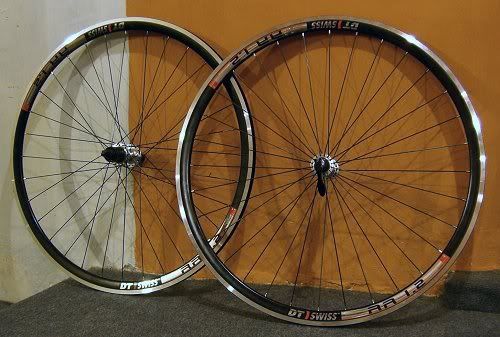 The spoked wheel is one of the critical technologies that makes bikes work: it is incredibly strong, incredibly light, and pretty much changed the world. The social revolution that came with the bike depends on the cheap reliable ubiquity of tensioned, tangentially-spoked wheels.
Building wheels makes me smile. The whole blacksmith thing comes in: taking bits and making a whole using skill and a little finesse; ending up with a whole greater than the sum of the parts. It is to fettling what compiling is to code: you get something useable at the end of it, but you may need to frotz around a little first. But it's not a black art, unlike, say, regex or the perfect flapjack.
These are my new race wheels: stock Bontrager hubs, DT Swiss RR 1.2 deep-section aero rims, laced up with black Sapim double-butted stainless spokes. Should be tough and fast and durable. The front is radial, mostly for looks; it's my first full-size radial wheel, and they're fussier to build than tangentially-spoked wheels. And not finished a moment too soon, either: these are what I'm racing on on Sunday morning. So if I screwed up, that's when I get to spit out my dental work :)


![[identity profile]](https://www.dreamwidth.org/img/silk/identity/openid.png)
no subject
Date: 2007-07-06 11:42 pm (UTC)I know that I could just look this up, but I tend to run with the assumption that geeks of all stripes (computer, scifi, bike, car, etc.) take simple pleasure in explaining things to them wot don't grok it already. So: what's the difference, in terms of assembly and performance, between radially and tangentially spoked wheels?
no subject
Date: 2007-07-07 12:01 am (UTC)Radially-spoked wheels transmit everything directly, so they are harsher to ride. They are not as strong due to the uncrossed spokes, and they also put greater forces on the hub flange which can cause hub failure. The advantages are slight: shorter spokes are lighter so a radial wheel saves a couple of ounces of spinning weight; radial wheels have a cleaner aerodynamic profile.
Radial lacing is unsuitable to deliver torque - it would just "wind up" the spokes. Radial front wheels are relatively common on road bikes; on a rear you'd only see radial lacing on the non-drive side. You can't use a radial with a disk brake for the same torque reasons.
As for tension and truing, a tangential wheel is a big bucket of averages, so it's very easy to get very nearly right. As long as the spokes are the right length, it's hard to make a really bad wheel. One generally adjusts tension in pairs. With radials, each spoke directly affects two points on the rim: its immediate entry, and its opposite. It's basically less subtle, and I suspect the reason it's harder to do is because mostly, people build tangential wheels - they're almost always better for the job!
Really bored bike mechanics do other, more elaborate spoke patterns. They're almost entirely decorative.
no subject
Date: 2007-07-07 12:34 pm (UTC)I don't have posh deep-section rims. Frankly I suspect the advantage of a few grammes of weight and a minuscule amount of aero is lost in my big bobbly helmeted head. Not to mention the bike having a great big ape sat on top of it. I'd lose more weight by taking one fewer power gels and changing my shoes.
Mind you, I do have latex tubes in there...
But that's for the ride sensation. Really. No, really. And carbon fibre bottle cages are seriously just for the bling. I'm not a weight weenie at all.
Still wanna megadoodle.
no subject
Date: 2007-07-07 07:17 pm (UTC)no subject
Date: 2007-07-09 05:39 pm (UTC)no subject
Date: 2007-07-09 10:46 pm (UTC)The usual mistake is to make the spokes too loose, so they go a bit slack at certain points in the ride (i.e. at the bottom, or when honking out of the saddle). Spokes should be under tension all the time: it's a tension structure. Once they go slack, they can unscrew a little and flex, which lets the wheel get untrue and admits metal fatigue into them.